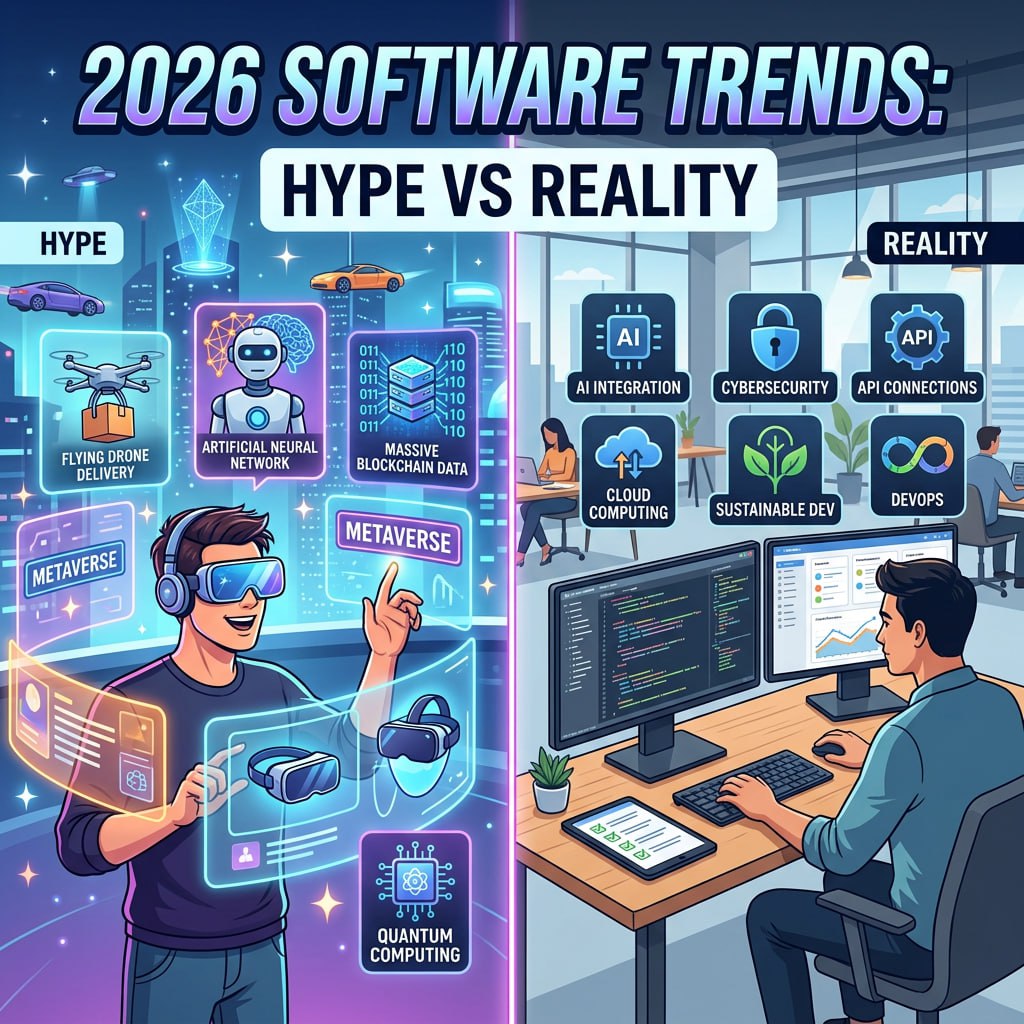
By March 2026, the dust has settled on last year's AI agent hype cycle. What landed in production and what stayed in the demo video?
Three months into the year, one thing is clear. The gap between what vendors promise and what actually ships is wider than ever. We have all sat through the "AI agents will replace your engineering team" pitch decks. But now that we are in March, which technologies are actually earning their keep? And which ones are still stuck on "coming soon"?
Let's cut through the noise.
If 2024 was the year of AI-assisted coding, 2025 was the year it broke. The "vibe coding" era, where developers asked an LLM to "make it work," hit a wall when those demos needed to talk to real databases, handle actual user load, and survive security reviews.
But something interesting happened. Teams pivoted. Instead of asking AI to replace engineering workflows, they embedded it into them. The result is first draft generation at prototype speed, but with guardrails. Think automated tests, linting, security scans, and human review gates. The 10 minute demo still takes 10 minutes. But the 10 week build? It still takes 10 weeks. The unsexy parts like integration, error handling, and observability cannot just be "vibed" past.
The real trend: AI acceleration through the first 80% of any task. The hard 20% (edge cases, failure modes, operational concerns) is still craftspeople work.
Local LLMs graduated from novelty to necessity. By early 2026, running a 7B parameter model on Apple Silicon or an NVIDIA Jetson is not a party trick. It is a product requirement for anything handling sensitive data offline.
The use cases that actually shipped? Medical devices processing patient data locally. Field equipment providing diagnostics without connectivity. Security systems with facial recognition that never phones home. The ROI story here is not about cost savings. It is about compliance velocity. When you do not need cloud approval cycles to update a model, you ship faster.
The "API first" promise has finally matured. In 2026, most serious internal systems expose APIs, and "integration" is not a dirty word anymore. The pattern that is working: treat your internal services like products, with versioning, documentation, and SLAs.
What is different is the tooling. Modern integration stacks now handle the observability, retry logic, and idempotency that used to be hand coded. The result is fewer 3 AM pages, faster time to integration, and systems that actually compose.
For a deeper dive into why integration remains the lion's share of software delivery, see our guide on what software actually is. And why the definition keeps shifting in 2026.
The "agentic" demos from 2024 were impressive. Until you saw the error handling credits roll. In production, agents that operate autonomously still hit the "cockroach problem." Rare, weird edge cases that do not exist in training data but absolutely exist in real user data.
Teams are converging on a hybrid model. Agents handle defined workflows with human escalation points, not open ended tasks. The fully autonomous engineering team remains science fiction. The useful pattern is human in the loop agents that accelerate decisions but do not own outcomes.
Zero code platforms hit their ceiling in 2025. They excel at CRUD apps, dashboards, and simple automations. But when you need custom algorithms, specialized integrations, or performance optimization, you still hit a wall.
The shift is toward "low code for scaffolding, full code for differentiation." Smart teams use zero code for the 80% boilerplate and augment with custom code where it matters. Exactly the pattern we see working in our smart prototyping engagements.
Code review tools powered by LLMs are widespread now, and they are genuinely useful. For the obvious stuff. Style violations, missing docstrings, deprecated API usage. But the real production bugs? The race conditions, the auth bypasses, the retry logic that only fails under specific concurrency patterns. These still escape automated review.
The pattern that works is AI pre review catching mechanical issues so human reviewers focus on architectural concerns and failure modes. It is an efficiency gain, not a replacement.
Software delivery is still 80% integration, 20% novel code.
The stack got higher, the abstractions got better, but the fundamental truth remains. Most of the time, money, and risk in a software project sits in connecting A to B to C, handling the edge cases where they disagree, and making sure you can tell when it is broken.
Testing, monitoring, and security remain non negotiable.
No tool, no matter how AI powered, replaces the discipline of knowing how your system fails. Observability, rollback capability, and security review are not accelerators. They are brakes that let you go fast.
Communication beats tooling.
The teams shipping quality software in 2026 are not the ones with the newest frameworks. They are the ones with clear requirements, tight feedback loops, and a shared understanding of what "done" looks like.
Speed of prototyping: 10x faster.
The first version of anything is now dramatically faster to build. AI assisted coding, component libraries, and better dev tools mean concepts become clickable demos in hours, not weeks.
Cost of experimentation: 10x cheaper.
Because prototypes are cheap, teams can validate ideas before committing. The sunk cost fallacy is less deadly when the sunk cost is measured in days, not months.
Distance from prototype to production: Still painful.
Here is what did not change. The gap between "works in the demo" and "works at scale under load with real users" is still where projects live or die. The acceleration at the front end of projects has not eliminated the hard integration, performance, and operational work at the back end. It has just changed when you confront it.
For teams navigating this gap, our Virtual CTO service provides the architectural guidance to move from prototype to production without the usual surprises.
Four principles we are seeing from teams who consistently ship:
1. Adopt fast, validate faster.
The cost of being wrong has collapsed. Try the new framework. Test the AI tool. But set kill criteria. If it does not deliver within a defined window, cut it loose. The risk is not in trying. It is in continuing to try after the data says stop.
2. Invest in the "unsexy" layer.
Monitoring, observability, rollback capability, automated testing. These are not accelerators. They are force multipliers for everything else. A team with poor observability moves slowly because they cannot safely move fast. A team with solid foundations can absorb acceleration elsewhere.
3. Hybrid teams with clear boundaries.
AI tools are teammates, not replacements. Define clearly what AI handles (first drafts, boilerplate, mechanical review) and what humans own (architecture, failure modes, user outcomes). The teams in crisis are the ones who blurred this line until something broke.
4. Own your integration points.
External dependencies remain your biggest risk. APIs you do not control, SaaS tools that change pricing or features, cloud providers with region outages. The more you can internalize critical paths or at least abstract them behind interfaces you control, the more resilient you become.
If there is one lesson from early 2026, it is this. Technology does not replace engineering discipline. It raises the ceiling on what is possible with it.
The teams winning right now are not the ones using every new tool. They are the ones who understand the difference between a demo and a product, who invest in the unsexy infrastructure that lets them move fast safely, and who know that software development remains fundamentally about understanding problems, managing complexity, and delivering value.
The tools got better. The fundamentals did not change.
Wondering how your software strategy stacks up against 2026's realities? Let's talk.
Written: March 2026
Reading time: ~7 minutes
Topic: Software Development